
How to Calculate Loan EMI Manually: Formula and Examples
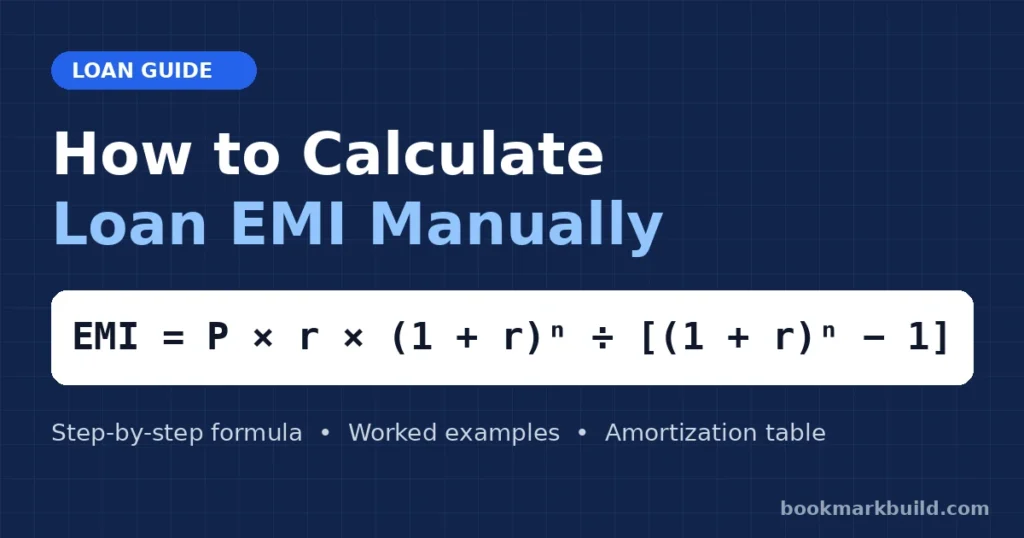
Quick answer: Use the formula EMI = P × r × (1 + r)n ÷ [(1 + r)n − 1], where P is the loan amount, r is the monthly interest rate (annual rate ÷ 12 ÷ 100) and n is the tenure in months. For example, a ₹10,00,000 loan at 9% for 5 years has an EMI of about ₹20,758. If you just want the answer in a second, use our free Loan EMI Calculator.
What Is EMI?
EMI stands for Equated Monthly Instalment. It is the fixed amount you pay your lender every month until the loan is fully repaid. Every EMI has two parts:
- Interest: the cost of borrowing for that month.
- Principal: the part that actually reduces your loan balance.
The EMI amount stays the same each month, but the mix changes. In the early months most of your payment goes toward interest. Towards the end, most of it goes toward principal.
The EMI Formula
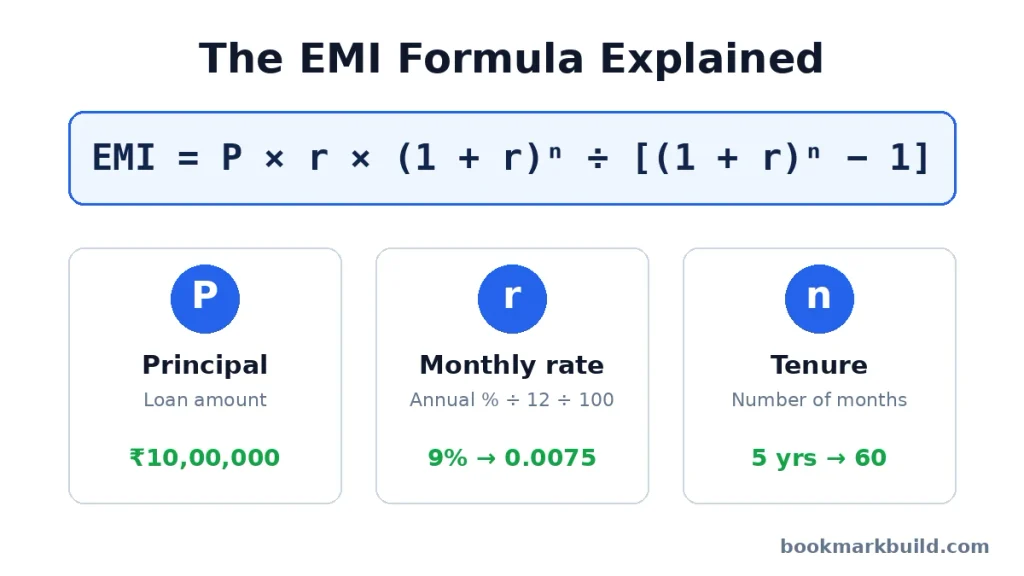
Convert the annual rate to a monthly decimal and the tenure to months before you start.Almost every bank uses the reducing-balance EMI formula:
EMI = P × r × (1 + r)n ÷ [(1 + r)n − 1]
| Symbol | Meaning | Example |
|---|---|---|
| P | Principal (loan amount) | ₹10,00,000 |
| r | Monthly interest rate (annual rate ÷ 12 ÷ 100) | 9 ÷ 12 ÷ 100 = 0.0075 |
| n | Loan tenure in months | 5 years = 60 months |
The two most common mistakes are using the annual rate instead of the monthly rate, and using the tenure in years instead of months. Always convert both before you start.
How to Calculate EMI Manually: Step by Step
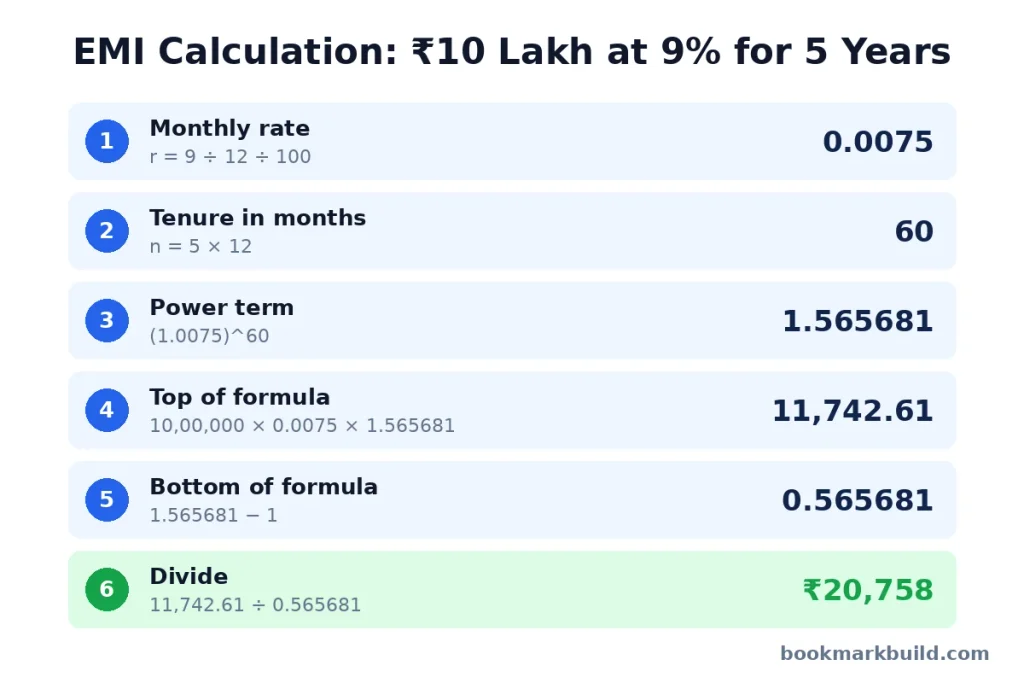
The six steps of a manual EMI calculation at a glance.Let’s work through a real example: a loan of ₹10,00,000 at 9% a year for 5 years.
Step 1: Convert the annual rate to a monthly rate
r = 9 ÷ 12 ÷ 100 = 0.0075
Step 2: Convert the tenure to months
n = 5 × 12 = 60 months
Step 3: Calculate (1 + r)n
(1.0075)60 ≈ 1.565681
This is the only tricky part by hand. Turn your phone calculator sideways to get the scientific keys, type 1.0075, press xy, type 60 and press equals.
Step 4: Calculate the top of the formula
P × r × (1 + r)n = 10,00,000 × 0.0075 × 1.565681 = 11,742.61
Step 5: Calculate the bottom of the formula
(1 + r)n − 1 = 1.565681 − 1 = 0.565681
Step 6: Divide
EMI = 11,742.61 ÷ 0.565681 ≈ ₹20,758
So a ₹10 lakh loan at 9% for 5 years has a monthly EMI of about ₹20,758.
How Much Interest Will You Pay in Total?
Once you have the EMI, the total cost is simple:
- Total amount paid = EMI × n = 20,758 × 60 = ₹12,45,480
- Total interest = Total paid − P = 12,45,480 − 10,00,000 = ₹2,45,480
Total interest is the real price of the loan, and it is the number worth comparing when you look at offers from different lenders.
How Each EMI Splits Into Interest and Principal
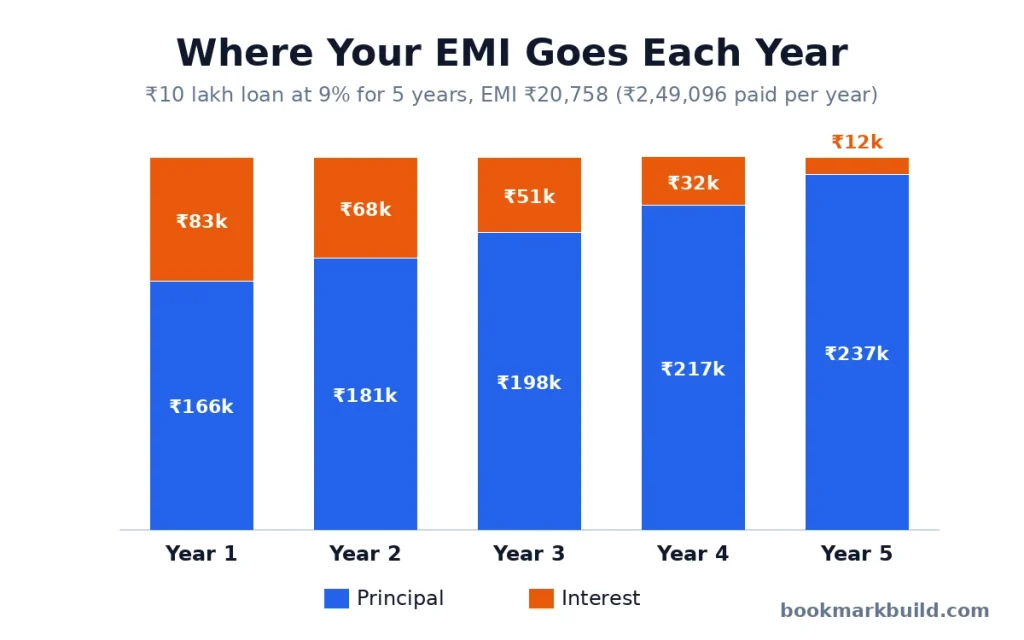
Interest falls every year while the principal part of your EMI grows.To see where your money goes each month, repeat these three steps:
- Interest for the month = Outstanding balance × r
- Principal repaid = EMI − Interest for the month
- New balance = Old balance − Principal repaid
Here are the first three months of our example:
| Month | Opening Balance | EMI | Interest | Principal | Closing Balance |
|---|---|---|---|---|---|
| 1 | ₹10,00,000 | ₹20,758 | ₹7,500 | ₹13,258 | ₹9,86,742 |
| 2 | ₹9,86,742 | ₹20,758 | ₹7,401 | ₹13,357 | ₹9,73,385 |
| 3 | ₹9,73,385 | ₹20,758 | ₹7,300 | ₹13,458 | ₹9,59,927 |
The interest falls a little every month while the principal part grows. Keep going and the balance reaches zero after month 60. This table is called an amortization schedule. Over the full loan, you pay about ₹83,000 in interest in year 1 but only about ₹12,000 in year 5.
Another Example: Car Loan
Let’s practise with a shorter loan: ₹5,00,000 at 10% a year for 3 years.
- r = 10 ÷ 12 ÷ 100 = 0.008333, and n = 36
- (1.008333)36 ≈ 1.348182
- Top: 5,00,000 × 0.008333 × 1.348182 ≈ 5,617.42
- Bottom: 1.348182 − 1 = 0.348182
- EMI = 5,617.42 ÷ 0.348182 ≈ ₹16,134
Total paid = 16,134 × 36 = ₹5,80,824, so the total interest is about ₹80,824.
Flat Rate vs Reducing Balance: Why It Matters
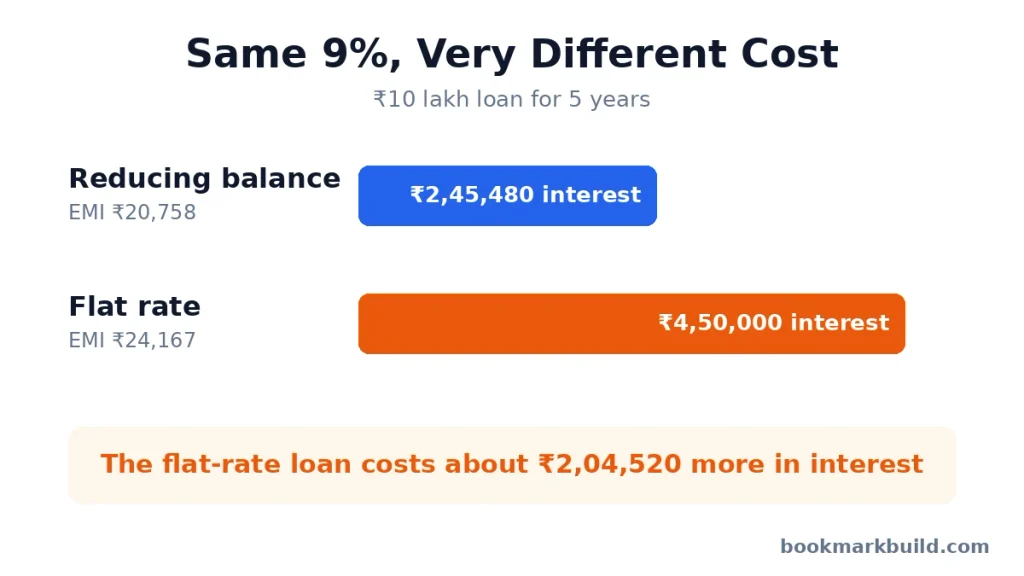
The same 9 percent costs over Rs 2 lakh more on a flat-rate basis.Some lenders, especially for personal loans, two-wheeler loans and consumer durables, quote a flat interest rate. A flat rate charges interest on the full original loan amount for the whole tenure, even though you are paying the loan down every month.
Flat-rate EMI = (P + P × annual rate × years) ÷ n
Using our first example at a 9% flat rate, interest = 10,00,000 × 9% × 5 = ₹4,50,000, so EMI = 14,50,000 ÷ 60 = ₹24,167.
| Method | EMI | Total Interest |
|---|---|---|
| 9% reducing balance | ₹20,758 | ₹2,45,480 |
| 9% flat rate | ₹24,167 | ₹4,50,000 |
Same “9%”, but the flat-rate loan costs over ₹2 lakh more. Always ask your lender which method they use.
Quick Ways to Double-Check Your Answer
- Excel or Google Sheets: type
=PMT(9%/12, 60, -1000000)and it returns about 20,758. - Sanity check: your EMI must always be more than P ÷ n (₹16,667 in our example). If it is not, the rate conversion is wrong.
- Online tool: enter the same numbers in the BookmarkBuild Loan EMI Calculator to confirm your manual result instantly.
Common Mistakes to Avoid
- Using the annual rate (9) instead of the monthly decimal rate (0.0075).
- Entering the tenure in years instead of months.
- Rounding (1 + r)n too early. Keep 5 to 6 decimal places until the last step.
- Forgetting processing fees and insurance. They are not in the EMI formula but still add to the cost of the loan.
- Comparing a flat rate with a reducing rate as if they were the same.
How to Lower Your EMI
- Make a bigger down payment to reduce P.
- Negotiate a lower rate or improve your credit score before you apply.
- Choose a longer tenure for a smaller EMI, but remember that it raises the total interest.
- Make part-prepayments when you can. Every extra payment cuts the balance, so less interest is charged from then on.
Frequently Asked Questions
What is the formula to calculate EMI manually?
EMI = P × r × (1 + r)n ÷ [(1 + r)n − 1], where P is the loan amount, r is the monthly interest rate as a decimal and n is the number of monthly instalments.
Can I calculate EMI without a scientific calculator?
Yes, but it is slow, because you have to multiply (1 + r) by itself n times. A phone calculator with an xy key, a spreadsheet or an online EMI calculator is much quicker and less error-prone.
What is the EMI on a 10 lakh loan at 9% for 5 years?
About ₹20,758 a month. Over 60 months you pay about ₹12,45,480 in total, of which about ₹2,45,480 is interest.
Does the EMI formula work for home, car and personal loans?
Yes. The same reducing-balance formula applies to any fixed-rate loan with equal monthly payments, whatever the loan type or currency.
Why does most of my early EMI go toward interest?
Interest is charged on the outstanding balance. At the start the balance is highest, so the interest part is highest too. As the balance falls, more of each EMI goes toward principal.
What happens to my EMI if the interest rate changes?
On a floating-rate loan, the lender either changes the EMI or keeps it the same and changes the tenure. To recalculate, use the current outstanding balance as P, the new rate for r and the remaining months for n.
Conclusion
Calculating loan EMI manually comes down to one formula and a few careful steps: convert the rate to monthly, convert the tenure to months, work out (1 + r)n and divide. Knowing how it works helps you check lender quotes, spot costly flat-rate offers and plan prepayments with confidence. When you want a quick, accurate answer with no maths, try our free Loan EMI Calculator to see your EMI, total interest and total payment in seconds.